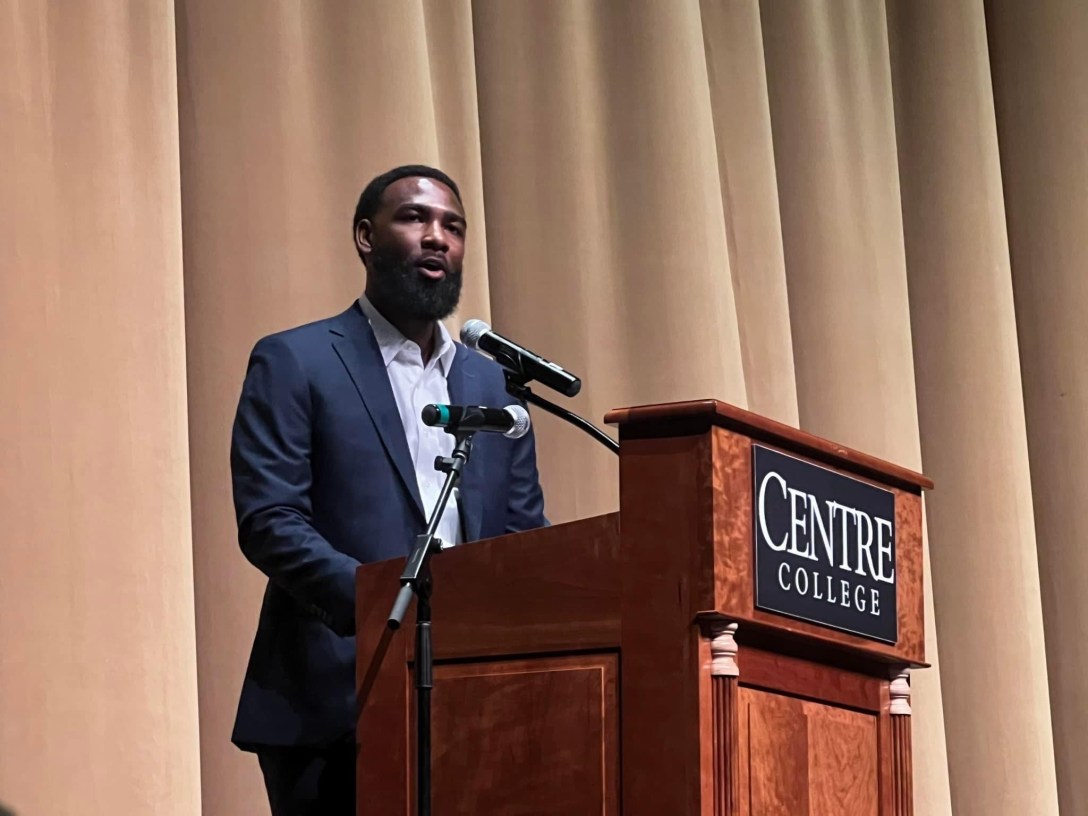
A speech I gave in Danville, KY on January 16, 2023 as part of Centre College’s annual Martin Luther King, Jr. Convocation.
Thank you for that warm introduction. Thank you, Danville. Thank you, Centre College. It’s been a long time. I’m excited to be back, and I am grateful for this opportunity to share with you my thoughts on Dr. King and what I’ve learned about community and change-making in the world outside of Centre since my time as a student.
So, let’s get into it! In my time up here I’m going to talk about three things:
First, I’m going to tell you a cautionary tale about me, and how in my last big attempt to transform an unjust system, I did not have a community mindset, and as a result…I didn’t too good.
Second, I’ll tell a few stories about Martin Luther King and show that even he needed the talents of a diverse and redemptive community to make a difference.
And finally, by the end of this, I hopefully will convince you that none of us actually needs to be great to succeed at change-making. That even Dr. King didn’t need to be great at everything to create a world that is more just than the one he inherited. By the end of my time, you will know my definition of a beloved community mindset, and why I feel that cultivating this mindset is the most useful thing that each of us can do today to make our world better during the short time we have on it.
First, it starts with me. As you heard, my name is Dexter Horne, and I was once a Centre student like many of you. I graduated from this school in 2016 and in the almost seven years since I have tried to do my version of Dr. King’s mission to make the world a more just, equitable, and inclusive place. And somehow, every day, I wake up to a world that is way worse than it was when I got here! Which is not at all what I expected from my life in 2012 when I first unlocked the door to my dorm room in Vinson Hall.
“I will study and be ready; then maybe the chance will come.”
Abraham Lincoln
Let me take you back to my mindset then. I came to Centre when the entire campus was on lockdown, not because of a global pandemic, but because this place was crawling with secret service agents as we prepared for a debate between then Vice President Joe Biden and Representative Paul Ryan. This was just a couple years after Boyle County went wet, and drinking aged students no longer had to drive to the next county to buy their Natural Lights and Burnett’s.
I personally didn’t have a Spotify account yet, and the most popular song on the radio was the main character complex theme music of every bangs-wearing manic pixy dream girl in America, a song called “Call Me Maybe” by Carly Rae Jepsen. A song which, I admit, slaps and that I still love despite the fact I that I have never been able to rock bangs myself.
Anyway, at that time, I walked onto campus with the swaggering confidence of a young millennial who knew very little about anything but was sure he could accomplish everything. And the one thing I really knew I wanted to do was that I wanted to be of service to the world. I was a Politics major and a Bonner Scholar after all, and I was sure of my ability to get things done if given the chance. I believed that all the world’s problems could easily be fixed by the learned, the driven, the charismatic…you know, folks like me!
“I will study and be ready; then maybe the chance will come.” They dropped down that Abraham Lincoln statue in front of Crounse my freshman year, and I would gaze up at it in wonder, drinking from those words inscribed in the statue’s stone base, the liquors of hope and faith: hope for a better America and faith in our ability to get there.
It wasn’t until I was in my mid-20s and out of school altogether that I learned how self-indulging and misplaced my theory on change was. Here’s what went down: I’m several years out of Centre now, I was 26 years old and overseeing all community service, political advocacy, and civic engagement work for the largest organization serving young professionals in Louisville, Kentucky. My team organized voter registration drives, hosted community service events and advocated for policies at the local and state level that we felt would make life in Louisville better for all the young adults like us in it. Overwhelmingly, my work and the work of my team was celebrated. No one in the entire city had a negative thing to say about me until the spring of 2020 when Breonna Taylor was killed.
That summer, hundreds marched past my home in the dead of night yelling, “Breonna was asleep too! No Justice, no peace.” As we masked up and marched with them, some of my peers were being tear-gassed, threatened and harassed by their own government. The deep tissue pain of being Black in America rang through every hollow corridor of society. And I and my allies on that young professional board wanted to do something about it, or at least say something about it.
Unfortunately, the more we tried to do, the more we tried to say, the more our presence made the leadership of that board uncomfortable. If we were to even utter the word “racism” something in their minds would immediately hit the panic button and attempt to shut down or divert conversation. When we suggested actions, our President would do mental gymnastics trying to find ways to disable us from moving forward then punish us for making him look like the bad guy. Those against us would talk at length about how they hated racism and how they wanted to see it eradicated from our city and in the same breath tell me that my suggestions were “too political,” or “not in our lane.”
I felt like I was screaming into the ether for help while the world below shushed me for being too loud. And instead of help, I got retaliation. The organization’s president began lashing out at anyone who spoke up for greater action. Once it was obvious that we had lost, my good friend on that board and ally in this drama, Leah Kelly, another Centre alum, asked me to “protect my peace” and know that we had done all that we could. But again, I thought my determination and intelligence were enough; so, I started lashing out right back. I pushed even harder.
At the end of the year, after fighting openly with its leadership, I ran for president of the organization so that I could have full control of its vision. Of course, after pissing off the dude with the most power on that board, I’m sure you all can guess how that went! Not only did I not win, but the current President, the white guy who blocked everything I tried to do, kicked me off the board entirely.
I can laugh about it now, but at the time I was devastated. I was frustrated with myself, with my inability to make the small corner of the world I felt like I was in control of respond in this moment of social unrest. I was afraid that I had thrown away my reputation to fight for an anti-racist future that I believed in but for which I had failed to get results. And I was surprised. I studied, and was ready, but when my time came to step up, I had been knocked down hard.
It was in the shadow of this disappointing time that I found a book by Taylor Branch called Parting the Waters: America during the King Years, 1954-1963. Despite that book being as long and dense as a dictionary, and thus something I would NOT have read were it assigned to me when I was a student here, I read the whole thing. And I read it because I was hoping to learn more about Dr. King and how he accomplished so much in a time of high racial conflict. And to be honest, I wanted to learn a little more about myself and why I had managed to accomplish so little in 2020 when racial animus was at a high point again. Here’s what I learned.
…a beloved community mindset…[is] one that allows all people to contribute to our project for a more perfect union and moves beyond ego and the politics of shame.
Dr. Martin Luther King Jr. is often heralded as a single, charismatic force that through will power and unnatural skills changed the world. That’s how I’ve always thought of him. But had he really believed that about himself, I’m sure he would have had as little success changing hearts and policy as I did on my young professionals board. The real story is much more complicated. Most of King’s deficiencies are forgotten or deemed unimportant only because he had a community of talented and passionate people around him who added their many skills to the movement so that someone else was always in position to pick up wherever he lacked. I want to give you a few examples of this.
First, I think it’s safe to say that Dr. King wasn’t the best boss. His organization, the Southern Christian Leadership Conference (or SCLC) was constantly hurt by the fact that he wasn’t very good at making sure that his operation was responsive, that the bills got paid, and that the rank and file felt valued.
Enter Stanley Levison a white, Jewish man who King considered to be one of his closest friends. Between 1957 and 1968 it is estimated that Dr. King gave around 2,500 speeches and traveled over 6 million miles to protest and march for civil rights. While King worked the microphones, Stanley Levison oversaw many of the day-to-day demands of the SCLC and professionalized its fundraising so that their movement wouldn’t go broke.
Additionally, Levison helped King draft early versions of his I Have a Dream refrain, which was famously ad-libbed during his speech at the March on Washington. Had not this friendship between a Black Christian preacher and a white Jewish attorney blossomed, it’s possible that King’s organization would have went bankrupt and one of the most famous and politically galvanizing speeches of American history would have fallen flat and been left out of our history books.
Another limitation that Dr. King had was that he was in the Black male preacher elite, and wasn’t always great at connecting with women, youth, or folks who were lower class. Fortunately, here too he had help. Ella Baker was a political activist who, along with many other Black women, did the bulk of the hard labor of the Civil Rights movement.
She had the unenviable job of organizing the SCLC’s dangerous voter registration drives in 10 states across the Jim Crow South during a time when the organization provided very few resources to the task but demanded results. She also invited arguably the most important demographic to play a more prominent role in the Civil Rights Movement: young people.
Baker encouraged the creation of the Student Nonviolent Coordinating Committee or SNCC. SNCC would go on to the support the Freedom Rides and the March on Washington and created new leaders for the movement such as John Lewis, Fannie Lou Hamer, and Stockley Carmichael.
From the pictures of young lunch-counter protestors having drinks poured down their heads to the burning freedom ride bus in Alabama, to the iconic photos of hundreds of thousands standing on the Washington Mall demanding jobs and freedom; some of the hardest fought battles of King’s movement were planned and fought by the young, the poor men, and by women of all colors and creeds. For Dr. King to become the Dr. King we celebrate today, he needed folks like Ella Baker by his side too.
King also owed his entire leadership philosophy not to himself, but to a queer, Black man. During a time of nearly unfathomable homophobia, the guiding conscious of the fight for racial equality were the thoughts and labor of a guy named Bayard Rustin. For it was Rustin who taught King the tactics of nonviolent resistance. The most pivotal moment of the era, the one stapled in our memories of Dr. Martin Luther King Jr.; was also thanks, in large part, to this leftist, radical, gay Black man. Rustin managed to organize the March on Washington in less than 60 days. Many of us in this room would have never heard Martin Luther King’s dream had it not been for the leadership and talent of a queer person.
Finally, for all the social power that Dr. King carried, he lacked the political power to get the change he wanted to see. For that, he needed to add to his community the people he had the most disagreements with: white moderates. He especially needed two important white moderates to take on personal risk and join him in his dream for a better America: John and Robert Kennedy. Just as folks like Levison, Baker, and Rustin were needed to create and sustain the Civil Rights Movement, King needed the Kennedys to turn the movement’s demands into policy.
For years, neither brother wanted to do it. President John Kennedy and Attorney General Robert Kennedy are remembered as civil rights champions, but they were not Martin Luther King’s friends, and they spent most of their time in power begrudgingly assisting him.
Their relationship with King was one filled with snubs, broken promises, and such a lack of trust that they approved an FBI wiretap on him. But in all this time, Dr. King never severed his relationship with these brothers, he never publicly eviscerated them though he had many reasons to want to. Despite the deep chasms between these leaders, King kept working with them both, believing in their quiet desire to do what was right, and remaining hopeful that they would one day join the side of justice.
And in the end, due to the persistence of the movement and its leaders, they both came to see the urgent need for civil rights legislation. Their public support for a civil rights package paved the way for President Lyndon Johnson to take up the fight after President Kennedy’s assassination. The rest, of course, is history, but only because King’s beloved community was willing to accept even its critics.
King understood that the individual cannot dismantle unjust systems, but the individual can challenge those systems wherever the two meet and encourage others to join them in that work. The individual can make their challenge stronger by choosing to display empathy and seeking mutually beneficial relations with people who desire a better world instead of seeing every encounter with someone different as zero-sum.
What Martin Luther King Jr. was brilliant at, and what Dexter Horne has not been so good at doing, is extending that empathy, that belief in redemption to those he didn’t like and to those who didn’t like him.
That superpower is at the heart of a beloved community mindset. In learning these things about Dr. King I’ve come to define that mindset as one that allows all people to contribute to our project for a more perfect union and moves beyond ego and the politics of shame.
That’s what I’ve been getting wrong on my own growth journey since my time as a bright-eyed freshman at Centre, listening to Carly Rae Jepsen, pretending to have bangs and stealing pennies from Abraham Lincoln’s feet.
To do the hardest things, we need to lead with a mindset that includes even our critics in our plans for a brighter tomorrow.
The President of that organization that booted me, I never tried to bring him into my way of thinking. I was angry with him for not getting it, for becoming afraid and rejecting my desire to fight for an organization and a world that he didn’t recognize. I made him feel like the bad guy: the privileged white boy who failed up into a leadership position in which he had proven to be woefully unprepared for. I made him feel stupid. I made him feel like a racist. I made it known that I didn’t like him.
Now, it’s also fair to say that he did all these things to himself. He shouldn’t have abused his power, he shouldn’t have been so afraid, he shouldn’t have been in that position, he shouldn’t have been acting racist. All of that is very true.
But it is also true that I, in my stubbornness, made “doing the right thing” less about finding strategic ways to build my community of people who would solve the problem, and I instead made it more about us vs. them; those fighting for equity, and those fighting against it. It wasn’t enough for me to want change, I also wanted to be vindicated for the hurt that I was feeling. Which is natural. Which is so so human. But, it’s also the opposite of acting out of a beloved community mindset fit to actually change unjust systems.
Who knows if I would have succeeded in making that volunteer board take a firmer stance against racism had I let that one, white moderate in on my vision or had I the patience to massage his fears and find compromise. Certainly though, I would not have been ousted, and would have gotten more done in the long run had I not made him my enemy from the start. That’s the lesson.
My generation, the millennials, and Generation Z, is very good at seeing the value of people who differ from us. I think we too have the skill to bring the white Jewish man, the Black woman and the queer person together to create robust and lasting solutions to our problems.
Where we might improve is in learning how to expand our community so that even the conservative white man, the politically moderate lesbian, the capitalist-minded Latin American also see our push for justice as something in which they can contribute instead of only portraying them as villains against progress. To do the hardest things, we need to lead with a mindset that includes even our critics in our plans for a brighter tomorrow.
A community mindset does just that because it is equal parts inclusive and redemptive. With it, Dr. King helped inspire a movement that crossed race, gender, sexuality, religion, ideology and class that won Black Americans the freedom to do once impossible things.
Which brings me to my final point: at the end of the day, like Dr. King, none of us in this room needs to be individually great or exceptional to make our world more just. If the communities we cultivate are great enough to hold difference, to hold people accountable for their actions, and hold opportunities for growth and redemption; we can accomplish anything. And I do mean anything.
The strength of humankind has always been, and will always be, in our cooperation. We will win the tests of the 21st century together. We will heal the heavens whose ozone layer we depleted so that again the skies are places we turn to to see the face of faith instead of fear. We will force our governments to respect the cries of the rising seas and slow the doomsday clock which ticks with the sound of cracking ice shelves.
We will question our gods, the free-market forces that have made our country unsustainably inequitable and conceive of a new economic religion that centers the health of humanity over the gluttony of private wealth.
We will unsubscribe from patriarchy, and redefine manhood, so that masculinity is no longer defined by violence against self, against women, against the non-binary, against the other, but is instead the performance of a brave and selfless love that we can all be proud to practice freely.
We will study war no more and focus our energies on a politics of competing solutions instead of a politics of competing identities.
We will win, not because we as individuals are great…we aren’t, we suck, we keep proving that. We will win because we as a community suffer fewer demons when we lean on the better angels of our cooperative nature.
Danville, Kentucky; students, faculty, and staff of Centre College, the past isn’t over, it’s hardly even past. The heroes of the civil rights movement are not historical artifacts, that movement continues to this day, its heroes are in this very room.
I joked earlier that the world has only seemed to get worse since I started thinking about how to make it better. That might be true, but it is also true that in its current state it is primed and ready and due for improvement.
I hope that you will join me in that project by cultivating a mindset in your own life that is equal parts inclusive and redemptive. I am committed to this task and am ready to help any of you who are committed as well. So, Call Me Maybe, and let’s continue this conversation on how to make our beloved communities wider and our world more just.
Thank you and good night.
Note: the views and opinions expressed on PolitiFro are my own and do not necessarily reflect the position or views of my employer or any entity with which I am associated. Welcome to my mind and beware: it changes.
Like something you’ve read here? Sponsor the early morning coffees or late night beer that help make this blog possible. This is in no way necessary, but will make me feel good! Donate $5, $10, or any amount on Venmo: @Dexter-Horne or through CashApp: $DexterHorne. And as always, thanks for reading.

 PolitiFro
<
div dir=”ltr”>Thanks for sending this out. Abby and I were trying to find a stre
LikeLiked by 1 person