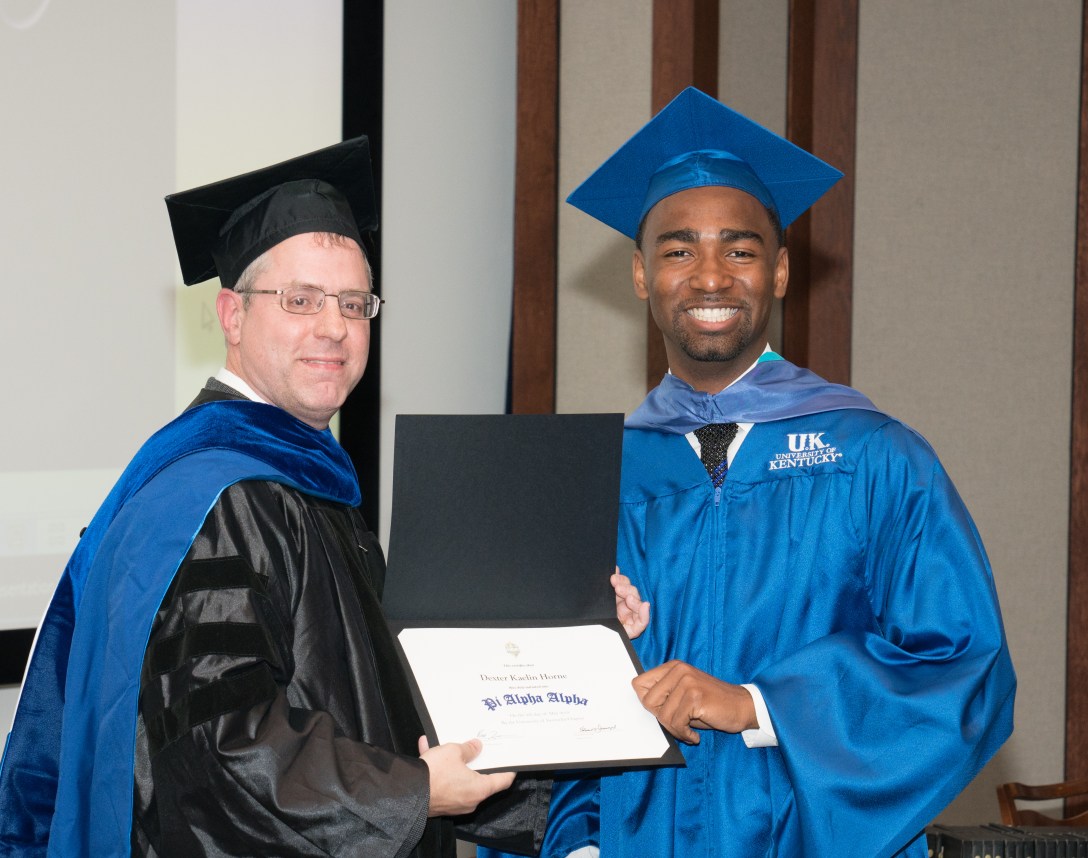
On May 4, 2018 I delivered the following speech to my peers and our families during the graduation ceremony for MPA, MPP, and PhD students of the Martin School of Public Policy and Administration at the University of Kentucky.
Alright! Good evening everyone. Happy Friday, happy spring FINALLY, and very happy to ditch this old backpack I found, because we are done! Seriously, I have been in school since before I could read–in fact that’s where I learned how–and it feels amazing to finally reach the end of this almost 20-year journey and to do so with all of you. Family and friends, thank you for being here today to celebrate this milestone with us. Thank you, Martin School faculty and staff, for putting together this event, for giving us knowledge and advice these past two years, and for sporting your beautiful wizard costumes on this hot spring day—all for us, we see you, and we thank you.
For those of you who don’t know me, my name is Dexter Horne. I am one of the graduating members of our MPA program. Dr. Petrovsky invited me to address this occasion with my thoughts as a graduating student of public policy and administration. And he asked me because “I know you love to talk.” So here I am, and I have decided that what I would love to talk about is something that is near and dear to all of our hearts: scientific experimentation. Yes. Our favorite subject.
Some of you with us today may still be curious as to what it is we actually do in public affairs. Well, I will tell you that a lot of what we do is science. Here at the Martin School we are taught to observe the complexities of all issues related to policy, budgets, and non-profits and explore solutions to these issues using the scientific method. With that we can tell you that, conditional on a variety of variables, under the auspice of complicated underlying assumptions, and with 95% confidence (meaning 1/20 times our results are due to random error), that our data suggests that something works…or it doesn’t. Yeah, very useful information if you can figure out what any of it means.
What we aim to do is create a universe with two identical populations, apply a treatment to one of them, and assess whether that treatment produces a specific outcome for that population or not. Being in the social sciences, we are almost never able to truly replicate this. It is a frustrating reality for us all, but what I want to focus on is that–even if we got these conditions right–we tend to forget that another frustrating possibility exists: that our treatment does not produce the effect we intended. That our experiment fails. As our friends in the physical sciences know, even when the causal mechanism is near perfect, experiments fail more often than not. Even in a controlled experiment, you can get results antithetical to the theory, past evidence, and carefully crafted methods that you built your hypothesis around. As the old story goes, Thomas Edison ran 1,000 unsuccessful experiments before he got his lightbulb to work.
I have experienced this Edison-esque frustration with experiments firsthand in my life. Way back, before I ever envisioned earning a Master’s degree, when I was sitting in the flimsy seat of a high school classroom I got my first harsh taste of the negative consequences of the scientific method. In those days, I was very bad at science. I was so bad that, by the time I reached Physics my senior year, I was embarrassed to go to class at all. See for me, in physics there were circuits that didn’t turn on lightbulbs, trains traveling at the same velocity to and from the same place but arriving at drastically different times, and freaky gravity and friction issues in my submitted work that were so bad that you would have thought that I was trying to prove that the world was actually flat.
Things came to a head for me in the weeks before our final assessment. I had already been accepted to Centre College at that time, and I was terrified that if I didn’t pass this Physics class the college would have grounds to rescind my scholarship offer. So, I developed a theory. My theory was this: if I study harder than everyone in this classroom from now until the final, I can make up for lost ground and do well enough to pass. A reasonable theory. Only, my theory wasn’t holding up. As the days disappeared, and the longer I studied, I found that I was still making mistakes. I was still falling short of the outcomes that I thought my earnest efforts and sound theory were promised.
Finally, I broke down and sent my physics teacher probably the most pathetic email I’ve sent in my life. Due to pride, and in the interest of time, I won’t read it. I’m sorry. But what is much more important was his response. He wrote me this; “Dexter…. the only way to truly gain confidence is to fail at something difficult, change your tactics, and try again until you succeed. With this outlook on life failure is never a final option.”
Those words, shared with me at the height of personal crisis, reshaped how I look at everything in life. And obviously, he was right. I worked with him to change how I studied and I passed that class. Then, I took Physics again in undergrad, and while I still did awful, I did a little better than the first time. And I tell this story because I think it has pertinence to the reality we will face as newly-graduated students who will soon become public servants.
See, we too are engaged in an experiment based on the soundest of logic and evidence-based theories that, despite our best efforts and earnest intentions, seems to fall drastically short of the outcomes our forbearers envisioned. I am talking about the great American experiment, the hypothesis of which being that we could build a country wherein all men and women were not only created equal but given equal treatment under our laws. Where people of all births were endowed by the creator with certain unalienable rights among them life, liberty, and at the very least, a fair shot at happiness. But as has been the case of many difficult endeavors throughout the history of humankind, this experiment has failed to produce the results that theory and method promised.
When young women must watch their harassers praised on the television we have failed. When young black men are made to feel their bones crack and blood spill at the hands of their protectors we have failed. When hardworking Americans are afraid to apply for college at the risk of deportation, people of faith fear to express the joy in their souls at risk of being treated like terrorists, we have failed. And when white working-class Americans are given no alternative but to see themselves as the villains in our history, deplorables who must be defeated instead of recruited to a common cause, then our American experiment has miserably failed.
In this, our 242nd attempt at this experiment, I fear—and you all may agree—that we are beginning to see the cracks in our resolve. We hear our friends and family express their deep-rooted distrust towards government. We also see our foreign brothers and sisters using our fear against us to weaken the democratic institutions and norms on which our experiment relies. And sadly, we know that we have raised false idols to the highest positions of power just to spite the old rule makers who tried without success to keep the American dream alive in both pupils of our divided country’s eyes. We seem to be abandoning hope in our nation’s old hypothesis in real time, all because we feel that the American experiment continues to fail us.
My peers in this graduating class, as future public servants we have inherited some difficult work. We are the inventors of tomorrow’s public policy. Soon, we will head the debates in the halls of power at the local, state, and federal levels, and we will shape the conditions under which our American experiment runs. As a result, we shall be responsible for the outcomes experienced 100 years from now and 100 years after that, and so on in perpetuity.
So, I leave you with this call to action that I plan to take to heart as well: when you see injustice in your workplace or in your community, change the method that leads to that result. When you sense that your decisions are being swayed by a tribe of like-minded people, increase your sample size. When you hear bigotry from the mouths of your coworkers and friends, challenge their confidence. When you hear such comments from your own mouth, find the bias your conscience is working to omit. And when you see the consequences of our nation’s mistakes take shape, do not excuse yourself from your civic obligation to evaluate where we went wrong, and motivate us to try things a different way. Thomas Edison eventually created that lightbulb. Dexter Horne passed Physics and is standing before you today. Our country has failed its people many times in the past, but I strongly believe that failure is never a final option.
America will succeed, and it will be because of persevering citizens and public servants like us. So, celebrate tonight with a tall glass of cougar bait and tomorrow with a refreshing mint julep because come Monday the experiment continues, and we have some important work to do. Let’s get to it.
Note: the views and opinions expressed on PolitiFro are mine only and do not necessarily reflect the position or views of my employer or any entity with which I am associated. Welcome to my mind and beware: it changes.
Like something you’ve read here? Sponsor the early morning coffees or late night beer that help make this blog possible. This is in no way necessary, but will make me feel good! Donate $5, $10, or any amount on Venmo: @Dexter-Horne or through CashApp: $DexterHorne. And as always, thanks for reading.


This has me prepared to run through a brick wall. I’ve always enjoyed your writing and I can’t imagine a single person in this audience wasn’t extremely motivated and charged for changing the world around them. Keep posting the great content.
LikeLiked by 1 person
Love you brother! Thanks for the support, and keep up the great work that you’re doing too. I know this message isn’t lost on you: you already have, and you’re going to continue to, make a lot of people’s lives better. You da man.
LikeLike